Handling a Rush Job or Emergency
Emergency calls are different. The customer is anxious, sometimes panicked. You don't have time to walk them through a leisurely intake. You skip the estimate, skip the formal approval, skip half the steps you'd normally do — and you accept some risk in exchange for moving fast. That trade-off is fine. The risk only becomes a problem when nobody documented the corners they cut, and a week later the customer is disputing the bill.
This article is about how to take those calls efficiently and leave behind enough record that the work, the price, and the customer agreement are defensible. Emergency work is the most billing-disputed work in the trades. The defense is documentation, and you have to do it in the moment because nobody comes back and reconstructs it later.
Why emergencies bite
Three reasons emergency work generates billing arguments more than scheduled work:
- The customer didn't formally approve a price. They were panicked; you were rolling. Nobody signed an estimate. When the bill arrives, the customer's panic has worn off and now they're asking why it was so much.
- The work happened outside normal hours. Overtime rates, after-hours surcharges, weekend differentials — all defensible, but only if the customer was told before the work happened, not after.
- The customer's memory is fuzzy. They were stressed, they don't remember exactly what was said, they especially don't remember exactly what was promised about pricing. Without records, it's their word against your tech's.
The discipline that protects you on emergencies is the same as the discipline that protects you on routine work, just compressed into less time and pursued with more urgency. Capture the work, capture the agreement, capture the payment.
Step 1 — Take the call without the full intake
Phone rings at 6:14 PM. Caller's water heater just burst, pressure relief is venting steam, they don't know how to shut off the water main, please come now.
Skip:
- The leisurely "and what's your email address?" beat.
- The "let me set up your account properly" beat.
- The careful tax-category and terms decisions.
Do not skip:
- Their name and a callable number. Both. You will probably need to call them back during the dispatch.
- The address, verified twice. Read it back. Wrong addresses on emergencies are catastrophic.
- The nature of the emergency, in their words. "Water heater burst, water pouring into garage" is enough. Don't try to diagnose on the phone.
- The earliest you can have someone there, and a quick agreement that they're okay with after-hours rates if applicable. "I can have a tech to you in about 45 minutes; this will be billed at our after-hours rate of [X] — does that work for you?" Get them to say yes verbally before dispatching.
The Account record at this point is a stub. That's fine. You'll fill it in tomorrow.
Step 2 — Dispatch fast
Open the dispatch board. Find a tech who's:
- Geographically reasonable. A tech across town with no current job will take 50 minutes to arrive; a tech 10 minutes away who's wrapping up another call can be there in 30. Closer wins on emergencies.
- Capable of the work. Not every tech does every kind of work. Match the skill to the emergency.
- On-shift or willing to be. After-hours work depends on who's actually on rotation tonight, or who's willing to take the call.
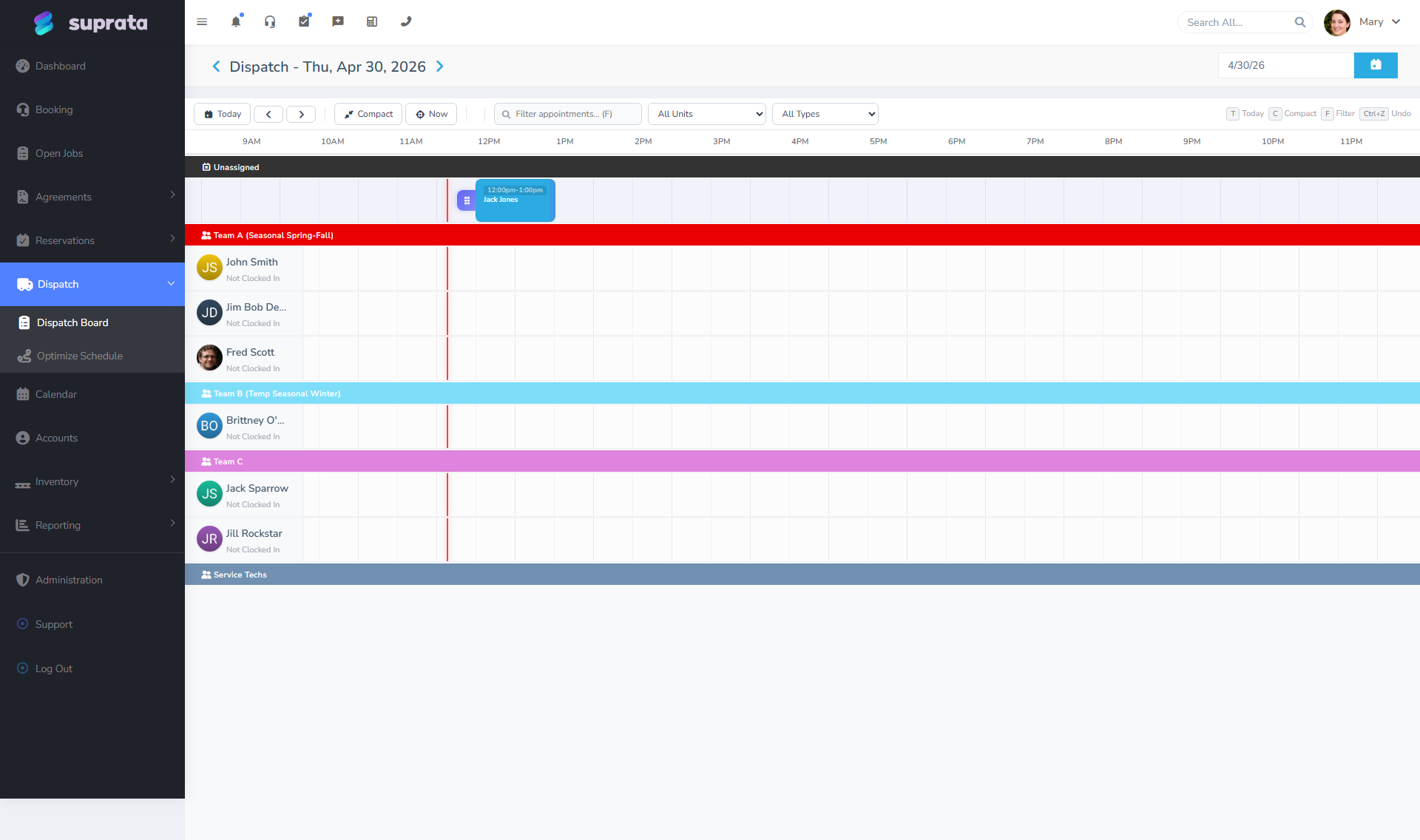
Drop the new emergency into the board. Phone or text the tech directly to confirm they got it; the in-app notification might be reliable, but on an emergency you don't trust async — you confirm out-of-band.
If you have GPS route optimization on, it'll suggest the right tech automatically. See GPS route optimization. On emergencies the suggestion is usually right because geography is the dominant factor.
Step 3 — Confirm with SMS, not email
The customer is in their kitchen with water on the floor. They will not be checking email. Send a confirmation by SMS:
- Tech name.
- ETA window ("estimated arrival 6:50 PM").
- A direct number to call if anything changes.
The "tech on the way" message goes out as soon as the tech is rolling. Customers in crisis appreciate knowing exactly when help is arriving — it's the single highest-impact message you'll send.
Step 4 — Capture upfront, or COD on completion
Emergencies are the place where payment timing matters most. Two reasonable patterns:
- Capture payment upfront. Before the tech leaves, charge a service-call fee plus an estimated minimum to a card on file or one the customer provides over the phone during the dispatch call. Lower risk on the back end, but adds friction to the front end ("you're charging me before you've even fixed it?").
- COD on completion. Tech captures payment on-site when the work is done, with a card reader or a saved-method charge. Customer signs for the work and the charge in one motion. Higher risk if the customer balks at the price post-work, lower friction in the moment.
For new customers on after-hours emergencies, upfront capture is safer. For existing customers in good standing, COD on completion is fine. Either way, get the agreement: "we'll capture payment when [tech name] is finished — what card would you like to use?"
Don't default to "we'll send you a bill" on emergency work. Net-30 invoicing on an emergency call to a brand-new customer is how unpaid balances are born. The customer has zero relationship history with you; the urgency that brought them to you is gone the moment the water stops; the willingness to pay drops every day after.
See Saved payment methods and when to use them.
Step 5 — Document with extra care
The tech is on-site, the work is happening. They should document with more care than a routine job, not less:
- Photos before, during, and after. Especially of any conditions that justify the cost (water damage, equipment age, parts that had to be replaced unexpectedly).
- Detailed notes on what was found vs. what was reported. "Customer reported water heater leak; on inspection, found relief valve had failed open; replaced valve and tested."
- Customer signature on the work-order, with the explicit price acknowledged. Many shops have a template for emergency work that says "I authorize this emergency repair at the after-hours rate of [X]" with a signature box. Use it.
- Time stamps. When did the tech arrive? Start work? Finish? Get back in the truck? On emergencies, billable time is contested more often than usual; precise times defuse the argument.
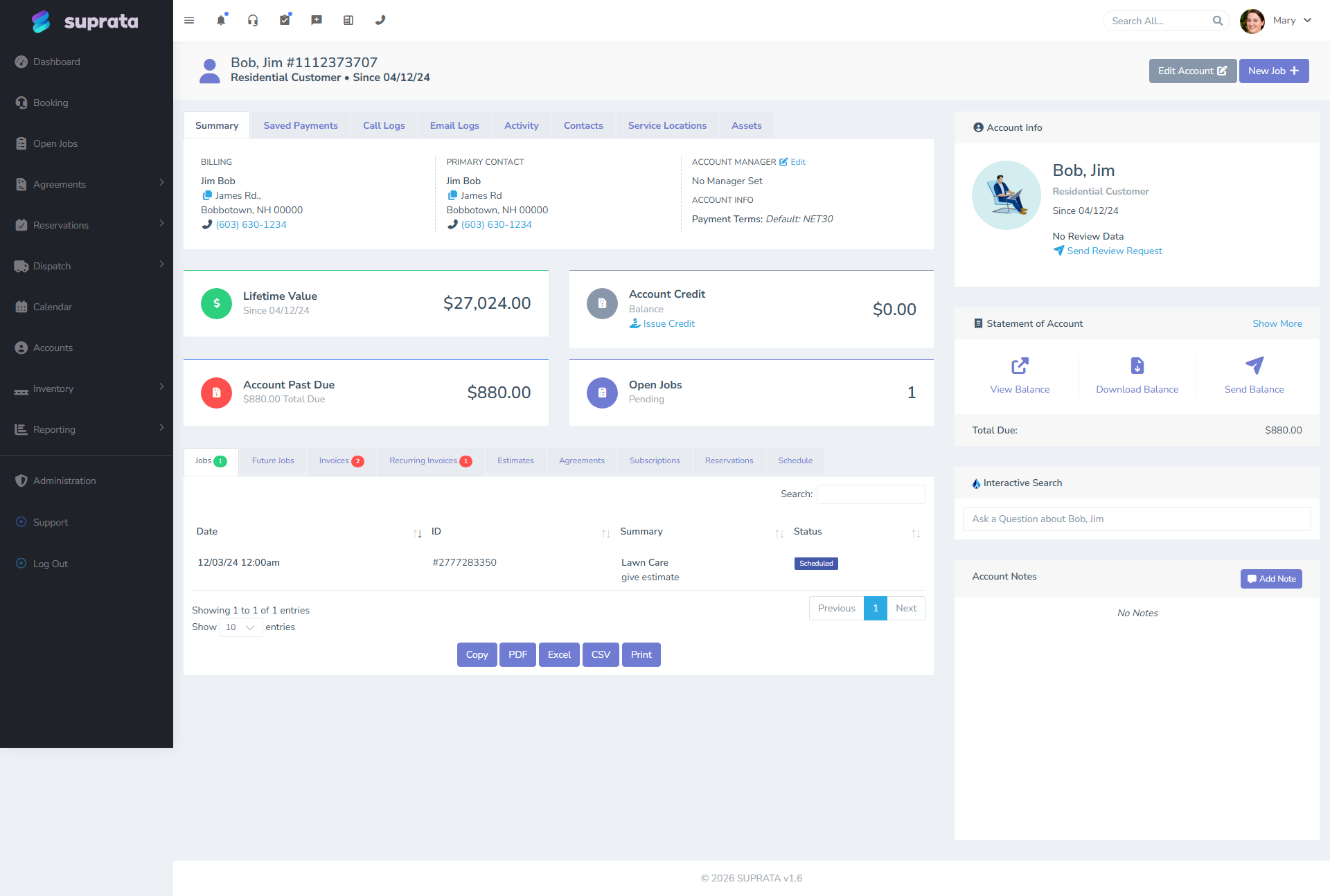
Update the Account record with the customer's full info — email, billing address, secondary phone — so future communication has somewhere to land.
Step 6 — Invoice immediately, even if paid
Even if payment was captured on-site, generate the invoice and email/send it the same night or first thing in the morning. The customer wants to see what they paid for, with line items, in writing. An emergency call where the customer pays $X and never gets an itemized invoice is a complaint waiting to happen — they'll dispute the charge with their card company in two weeks because "I never got documentation of what they did."
Email the invoice to whatever email you captured. Include photos as attachments if you took good ones. The professionalism of the post-work documentation is what converts a one-time emergency customer into a repeat customer.
See Sending an invoice to a customer.
Step 7 — Follow up
Twenty-four to forty-eight hours after the work, follow up. A short call or text: "Just checking in — is everything still working okay? Any issues?" This does three things:
- Confirms the fix held. Issues that resurface 24 hours later are easier to address while the work is fresh.
- Builds the relationship. Most companies don't follow up on emergency work. The ones that do are the ones customers call again.
- Heads off disputes. A customer who reports satisfaction in writing 24 hours later has a much harder time disputing the bill 14 days later.
Then — once the immediate fire is out — circle back and offer them a service agreement or a maintenance plan. Customers who just had a $1,200 emergency call are unusually receptive to "for $40 a month, we'd come out twice a year and check that this doesn't happen again." See Creating a service agreement.
What can go wrong
- Skipping the verbal price agreement at dispatch. Tech arrives, customer asks "how much will this be?", tech doesn't know what dispatch quoted. Customer is unhappy regardless of the eventual price because the conversation was never had upfront.
- Not documenting after-hours rate before work starts. Customer's mental price was the daytime rate; tech's bill includes the after-hours surcharge; argument ensues. The after-hours rate has to be quoted and acknowledged at dispatch, not invoice time.
- Net 30 on a new emergency customer. They pay slowly or never. Capture upfront or COD.
- No photos. Sounds optional; isn't. Photos are the single best billing-dispute defense, especially when the work involved exposing something the customer can't see (inside a wall, under a slab, behind equipment).
- No signature on the work-order. Customer signature with explicit price acknowledgment is the difference between a defensible bill and a he-said-she-said. Get the signature on the device, in the system, with timestamp, before the tech leaves.
- Sending the invoice three days later. Emergency customers want documentation immediately. A delayed invoice signals disorganization and invites disputes.
- Treating the emergency as one-off. Most emergency customers, treated well, become regular customers. Most regular customers came from emergencies. Don't end the relationship at the invoice; offer a follow-up and an ongoing-service conversation.
A small variation: after-hours from existing customers
When the after-hours call is from an existing customer with a service agreement or a long history, several of these steps soften:
- The Account already exists; just create a job and dispatch.
- They probably know your after-hours rate, but verbally re-confirm anyway.
- Payment is fine on terms because their history justifies it.
- Documentation still matters but the photo/signature discipline can flex slightly.
What doesn't soften: the dispatch speed, the SMS confirmation, and the same-day invoice. Existing customers calling at 9 PM expect fast and competent and you give them that regardless of agreement status.