Handling a customer dispute
A dispute (also called a chargeback) is what happens when a customer tells their bank that a charge on their card was wrong, instead of telling you directly. The bank pulls the money back from your account, charges you a fee, and gives you a window — typically 7 to 21 days, depending on the card network — to respond with evidence. If you don't respond, or your evidence isn't compelling, the dispute is decided in the customer's favor and you lose both the original payment and the fee.
This article covers how the dispute workflow plays out, what evidence to provide, and how the audit trail Suprata maintains around every job, message, and signature becomes your most important defense.
When a dispute happens
You'll learn about a dispute through your payment processor, not from the customer. Stripe (or USIO) will send an email and surface the dispute in their dashboard. Suprata may also flag it on the related invoice or payment record. The most common reasons a customer files:
- "I didn't authorize this charge." Card was used by someone else, customer doesn't recognize the charge on their statement, or — common in B2B — the cardholder didn't realize the AP person was paying.
- "The product/service didn't match what was described." Quality complaint, scope dispute, "I expected X but got Y".
- "The work wasn't completed." Especially common for partial-job billing or deposits on cancelled work.
- "I was charged twice." Real duplicates do happen; sometimes customers misread their statements.
- "Subscription or recurring charge I tried to cancel." Customer asked to stop, you didn't, charge went through anyway.
- Friendly fraud. Customer received service, isn't happy with their bill, and tries the dispute route instead of asking for a refund.
The reason matters because it determines what evidence is most persuasive. The dispute notification will include a "reason code" from the card network; read it carefully.
The clock is short
You typically have somewhere between 7 and 21 days to respond, depending on the card network and the dispute type. Stripe usually says exactly when in the dispute notification.
Miss the window and you lose by default. The instant you see a dispute notification, put the response on someone's calendar with at least three days of buffer. Don't wait until the last day; if you need a piece of evidence you don't have, you want time to find it.
What evidence to provide
The card networks weigh several types of evidence. The strongest are objective records that prove (a) the customer authorized the charge, (b) the work was performed, and (c) the customer accepted the work. Roughly in order of weight:
- A signed work order or estimate showing the customer agreed to the scope and price.
- Customer signature on the completed job (e.g., a tech captured a signature on the mobile job-form when work was completed).
- Photos of the completed work showing the work was actually done.
- Email or SMS communication with the customer about the work, scheduling, and any post-job conversation. The original sent invoice with the price they're now disputing.
- The invoice itself — properly dated, properly itemized, sent to the customer's email of record.
- Records of payment by the customer's own action. A self-service payment (customer entered their own card on the public payment link) is much stronger than a manually-keyed-in charge.
- Saved-method consent. If the charge was on a saved card, evidence the customer set up the saved method themselves (the saved-method record will show the date and IP).
- Service agreements or recurring billing authorizations if the charge is part of an ongoing arrangement.
Stripe and USIO have an evidence-submission form that walks you through fields for each of these. Fill in everything you can substantiate; leave blank anything you can't.
Where this evidence lives in Suprata
Suprata's strength as a dispute defense is that most of this evidence is captured automatically as you do business — you're not assembling it after the fact, you're collecting it from the system that already recorded it.
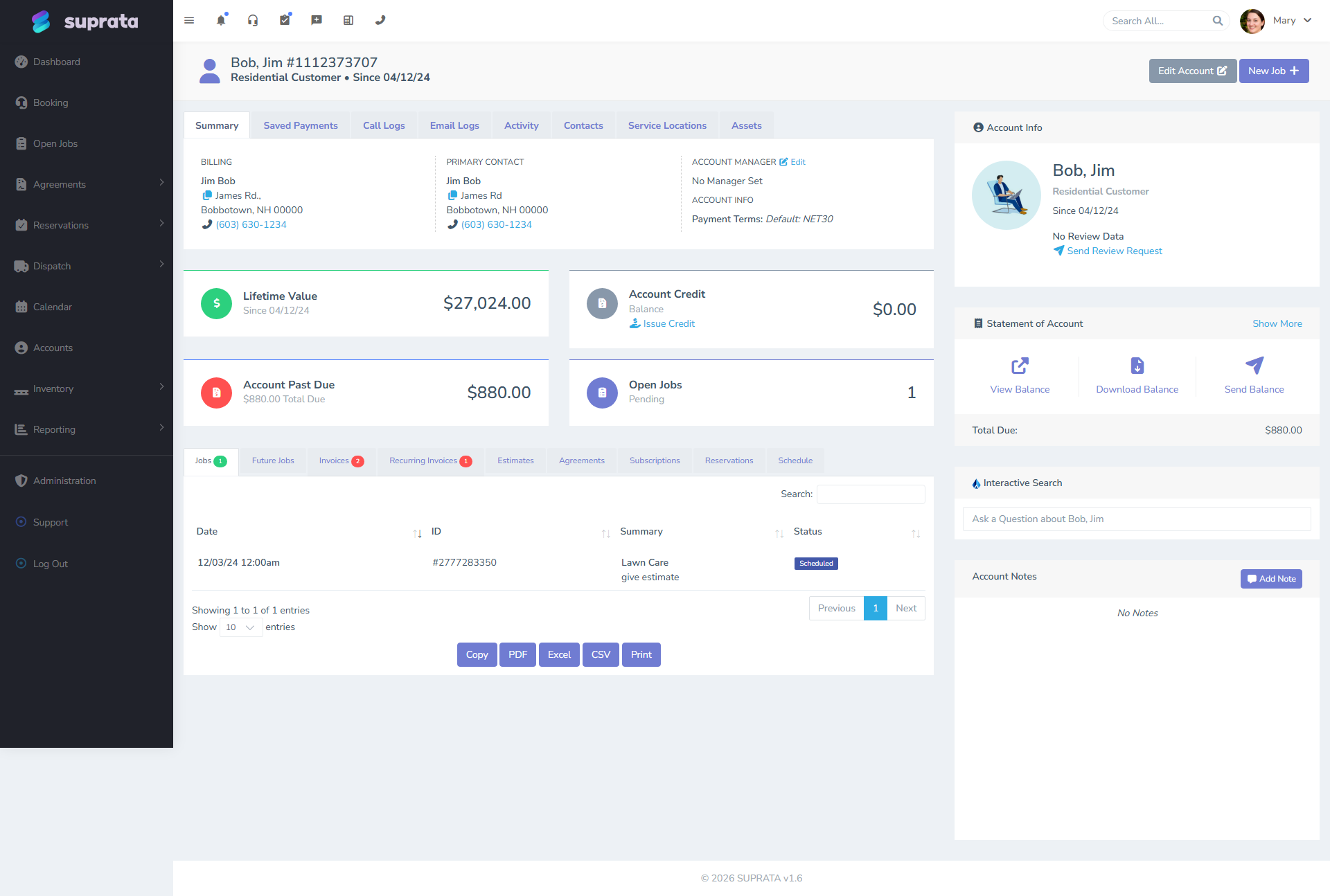
For a typical dispute, the evidence path is:
- The original estimate/invoice — pull the PDF that was sent. The invoice records its theme, terms, and the date it was sent; the email log shows when the customer received it.
- The job record — opens, scheduled date, tech assigned, completion timestamp.
- The signed completion form if your industry workflow captures one.
- Photos taken on the job if the tech uploaded any.
- Email and SMS history for that customer — every outbound message is logged.
- The payment record — when the charge was processed, what method, whether the customer paid themselves on the public link or you keyed it in.
- The invoice audit log — Suprata records every state change on an invoice (created, sent, viewed by customer, paid, closed). The "viewed" timestamp is gold: it shows the customer opened and read the invoice with no objection.
Pulling all of this together usually takes 30–60 minutes. Save the PDFs and screenshots into a single folder for that dispute, write a one-page narrative referencing them, and submit through the processor.
Writing the response narrative
The card network reviewers see hundreds of disputes. A clear, dated, factual narrative — even one paragraph — significantly improves your odds. Aim for something like:
On March 3, 2026, customer [name] requested service via [phone/web form/in person]. We provided a written estimate ($425) which the customer signed on March 4 (attached). Work was performed on March 7; the customer signed our completion form indicating satisfactory work (attached). The invoice was emailed to customer on March 7 at 4:42 PM and viewed by customer on March 8 at 9:15 AM (audit log attached). Customer paid via the public payment link on March 9 at 11:03 AM, entering their own card details (Stripe payment record attached). No objection was raised by customer until the dispute was filed on April 4.
Date everything. Reference attachments by name. Don't editorialize or argue — let the timeline speak for itself.
When to fight vs. when to refund
Not every dispute is worth fighting. Sometimes refunding before responding is the right call:
- Disputes where you genuinely owe a refund. Don't fight a dispute you'd lose on merits anyway. Issue the refund through your processor (which closes the dispute), eat the dispute fee, and learn from it.
- Tiny amounts. A $40 dispute may take an hour to fight; the dispute fee alone might be $15. If your evidence is weak, the math may favor cutting losses.
- Repeat-customer relationship at stake. Sometimes refunding to keep the relationship is worth more than winning the $200.
Conversely, fight when:
- Evidence is strong and the dispute is clearly wrong. Friendly fraud should not pay; if you can document customer authorization and completion, fight it.
- The amount is large. Above a few hundred dollars, the dispute response cost is dwarfed by the recovery.
- Pattern repeats. A customer who's disputed previously may try again; a clean win on this dispute makes future ones harder.
What happens after submission
Once you submit evidence:
- The card network reviews. This takes 30–75 days, typically.
- The funds are still pulled from your account in the meantime — you don't get them back yet.
- The network rules. If you win, the funds are returned (sometimes minus the dispute fee, sometimes with the fee returned too — varies by processor).
- If you lose, the funds stay pulled and the dispute is final. You can't appeal further on the same dispute, but you can pursue collection through other channels (small claims court, collection agency).
Track open disputes somewhere visible. Three months is long enough to forget a dispute exists; you don't want a "we won" to surprise you because you forgot to follow up.
Reducing future disputes
Most disputes are preventable with a few practices:
- Always send the invoice to the customer's email of record. If the dispute reason is "I never received an invoice", you want to be able to point at the timestamped delivery.
- Use the public payment link for customer self-pay. Customer-initiated payments are much harder to dispute as unauthorized. Avoid keying cards in over the phone whenever feasible.
- Capture signatures. A signed estimate before work, a signed completion form after. Even a photo of a handwritten signature on a paper form, attached to the job record, is meaningful.
- Document scope changes in writing. Don't agree to extra work verbally. Email or text the customer the new scope and price; their reply is your authorization record.
- Send post-job confirmations. "Your service was completed on Friday, total $425, payment received. Reply if you have any questions." Six months later, when the dispute happens, that email is your evidence the customer had every chance to object and didn't.
- Watch saved-method recurring charges. A customer who told you they wanted to cancel and got billed anyway is a guaranteed dispute. Honor cancellation requests immediately, and email confirmation that the cancellation was processed.
What about ACH disputes?
ACH has its own dispute mechanism (NACHA returns) — see Setting up ACH and when to prefer it. The most common ACH "dispute" is just an unauthorized return ("I didn't authorize this debit"), and unlike card disputes, you don't get to submit evidence and win — the return is automatic and final within the unauthorized-return window. Defend against ACH disputes by capturing strong, dated authorization (a signed agreement, a self-service payment portal entry, or both) at the moment the customer first authorizes ACH.
Common mistakes
- Ignoring the dispute notification. Missing the response window is an automatic loss. Treat every dispute email as time-critical.
- Submitting a one-line response with no documents. "Customer authorized this charge, please reverse the dispute" with nothing attached is a guaranteed loss. Attach the evidence.
- Arguing emotionally instead of factually. The reviewers don't care that the customer is unreasonable. They care about dates, signatures, and authorization. Stick to the timeline.
- Refunding through Stripe to make a dispute go away after submitting evidence. Once you've started the dispute response, complete it. Refunding mid-dispute can leave both the dispute and the refund in flight.
- Not capturing signatures on completed work. This is the single highest-leverage dispute-prevention practice. If your industry workflow has a signature step, use it religiously.
- Storing evidence only in email. When the dispute lands, you don't want to be searching three inboxes. The Suprata account record is your central source — keep notes, attachments, and history there.
- Treating disputes as rare and not having a process. They're not as rare as you'd hope. The first time you have one, build a checklist; the second time, follow it.