What's the difference between an account and a customer?
The short answer: an Account is a billable entity (a household, a company, an organization). A Contact is an individual person, who may be associated with one or more accounts.
You'll see the word "customer" used loosely in conversation to mean either, but in Suprata they're distinct records.
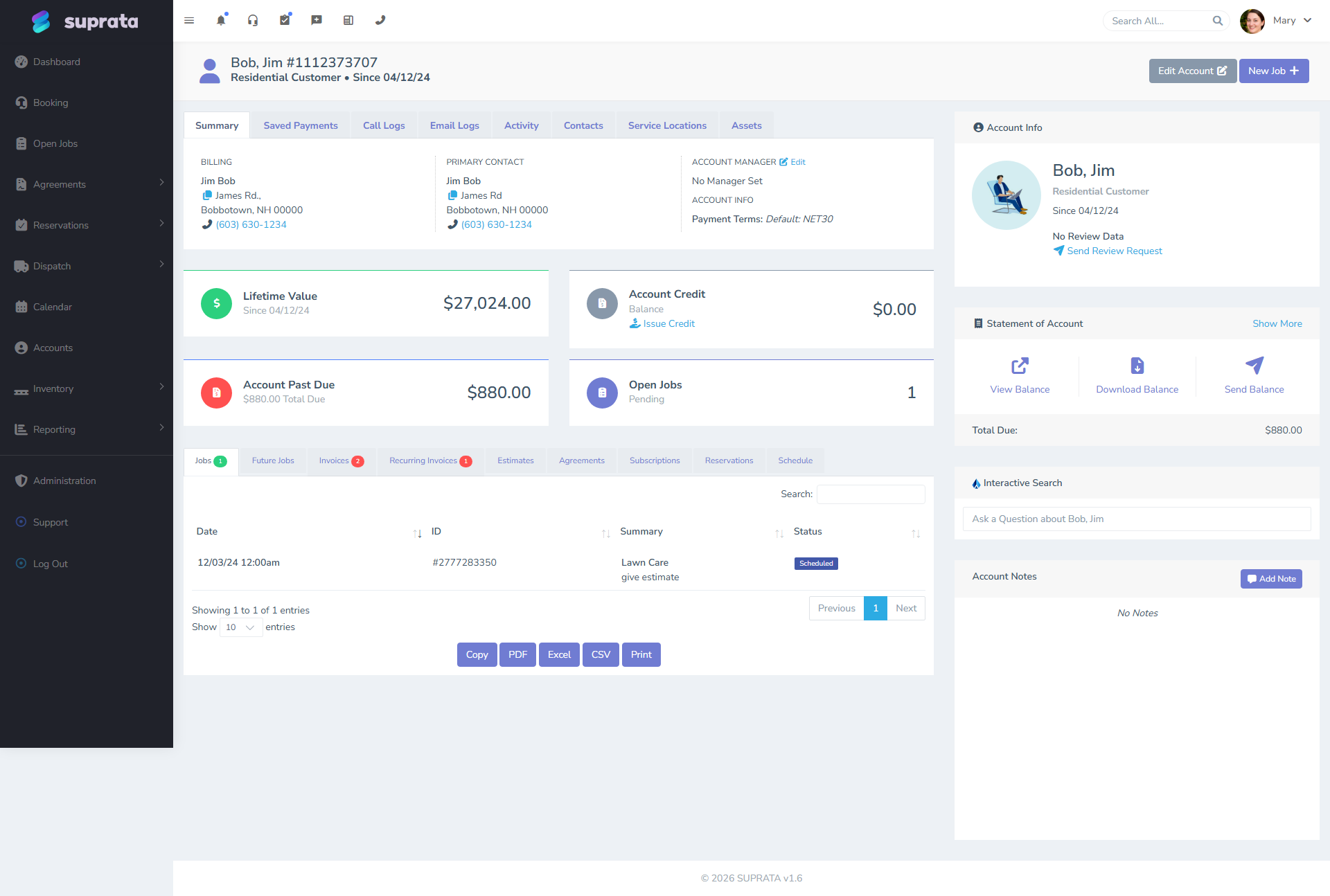
A quick example
The Smith family has two adults, Jim and Sally, both of whom call you for service. There's one Account ("Smith Residence") and two Contacts (Jim Smith, Sally Smith) linked to it. Invoices go to the account; calls and emails are tracked per contact.
For a commercial customer like ACME Corp, there's one Account ("ACME Corp") and several Contacts (their facilities manager, their procurement person, their accounts-payable contact). Same pattern.
Why this matters
- Invoices belong to accounts, not to individuals. You bill ACME Corp; AP sees the invoice.
- Communication can target either — call logs and emails are per-contact (you talked to Jim, not "the Smith family"), but billing reaches account level.
- Permissions sometimes differ — a tech might be able to add a contact without being able to create a new account.
The long version
For a thorough explanation including how this affects invoicing, communication, reporting, and the full mental model, see:
The anatomy of an account vs. a contact
That article also covers the data model, when to merge contacts, and the common naming-confusion pitfalls.
Related articles
- The anatomy of an account vs. a contact (the long-form explanation)
- Your first week with Suprata
- Can I import data from my old system?