Subscriptions vs. Service Agreements vs. Recurring Invoices
Suprata gives you three overlapping ways to set up an ongoing relationship with a customer. They all involve money showing up on a schedule, which is why people confuse them. But each one models a different kind of relationship — and picking the wrong one means you'll be patching around it for the life of the customer.
This is the article to read before you set up your first recurring anything.
The 30-second version
- A subscription is a recurring fixed fee for something the customer has access to (a membership, a slip rental, a "gold tier" program). It bills automatically. It does not produce jobs.
- A service agreement is a contract that schedules service visits. Each tick of the schedule produces a job (and usually an appointment), and may or may not produce an invoice.
- A recurring invoice is a billing-only repeating charge with no service component — a monthly retainer, a tool-rental fee, an HOA assessment.
If you're about to set up something recurring and the answer to "does this generate work for my crew?" is no, you're either picking a subscription or a recurring invoice. If the answer is yes, you're picking a service agreement.
What each one actually is
Subscription
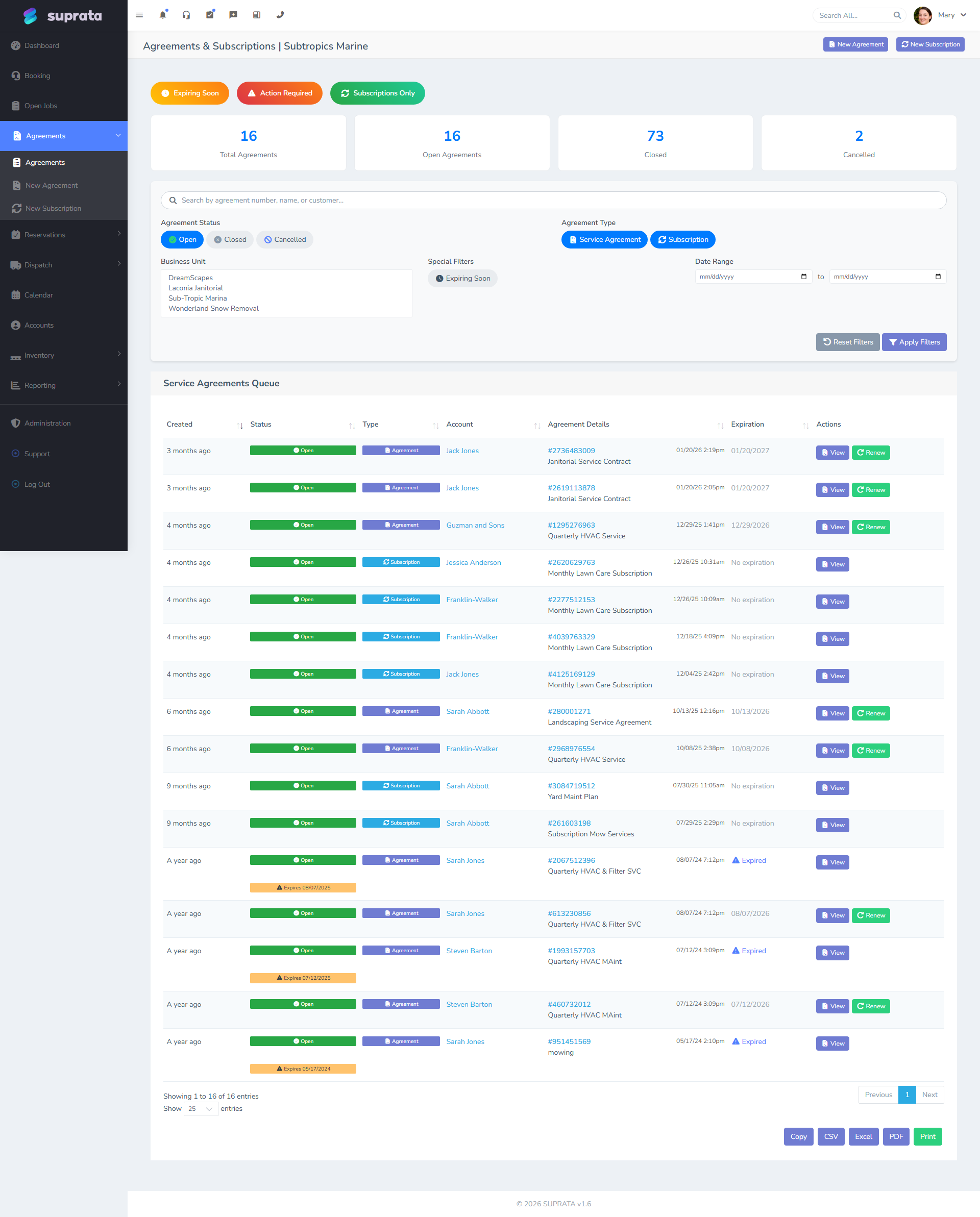
A subscription is a customer paying a fixed recurring fee for something — a status, a membership, an entitlement. The classic examples are:
- Annual pool club membership at a marina. The customer pays $1,200 a year and gets pool access. There's no "service" being rendered each month; you're just billing them for membership.
- Quarterly priority status for an HVAC company. The customer pays $99 a quarter to be at the front of the line when they call. No actual visits happen on a schedule.
- Monthly software fee for a managed-IT customer where the fee is "MSP base" — separate from any actual remediation work.
A subscription bills the customer on its cadence and nothing else — no job appears in dispatch, no appointment lands on the calendar. If a saved payment method is on file, the charge happens automatically; if not, the invoice goes out for collection like any other.
Service Agreement
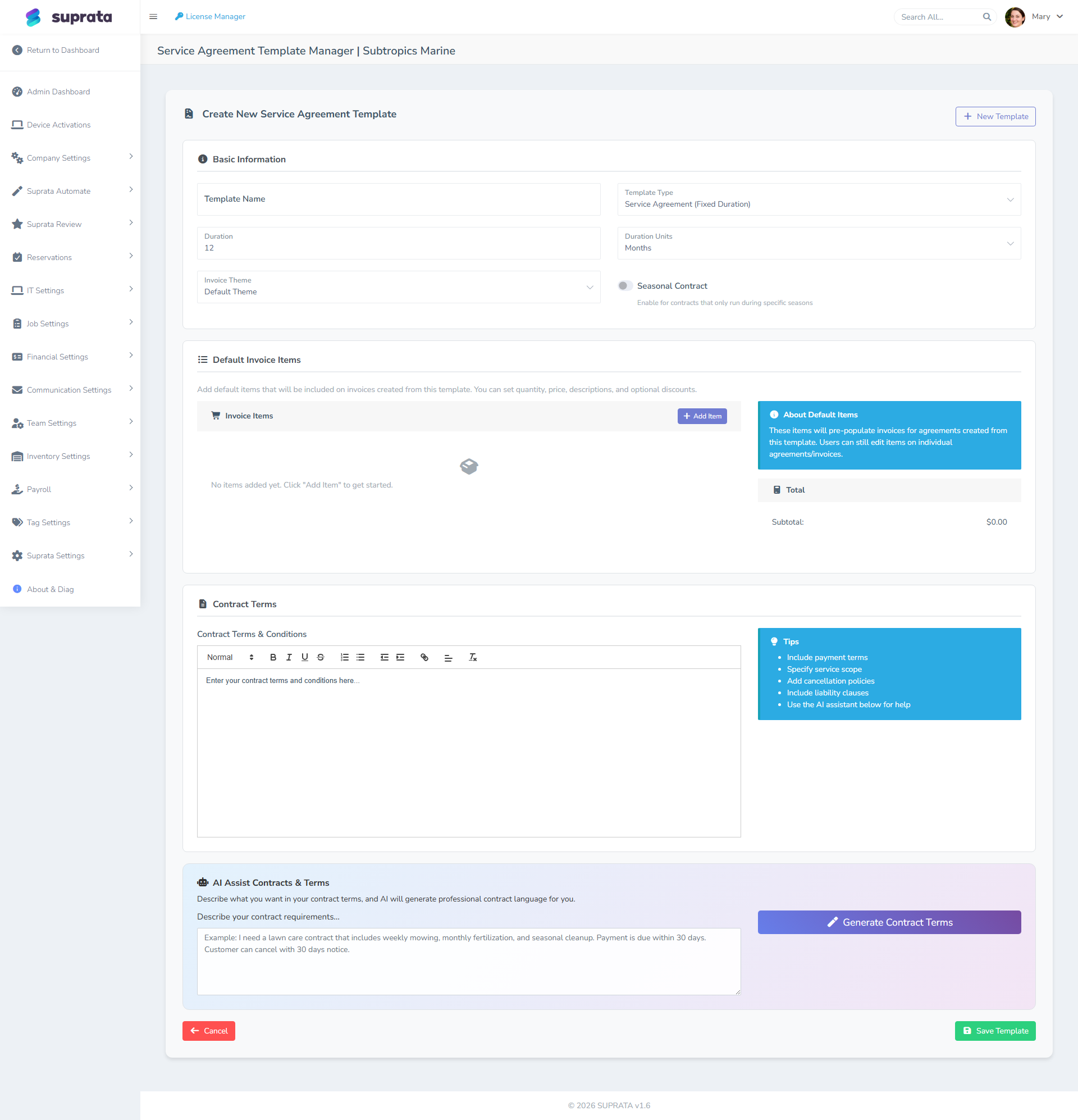
A service agreement is a contract between you and the customer that says "I will perform service X on schedule Y for the next Z months/years." Each tick of the schedule is a real piece of work that needs doing.
- Quarterly HVAC tune-up — every three months, your tech goes out and inspects the system.
- Monthly pest treatment — a tech shows up and treats.
- Twice-yearly chimney sweep.
- Bi-annual generator service.
Service agreements have two moving parts: a template (the boilerplate — terms, default items, default schedule) and an active agreement (one customer's signed copy, with their dates and details). When a cycle on the schedule comes due, Suprata creates a job, optionally drops an appointment on the calendar, and may invoice for that visit (depending on whether the customer pre-paid the contract or pays per visit).
Recurring Invoice
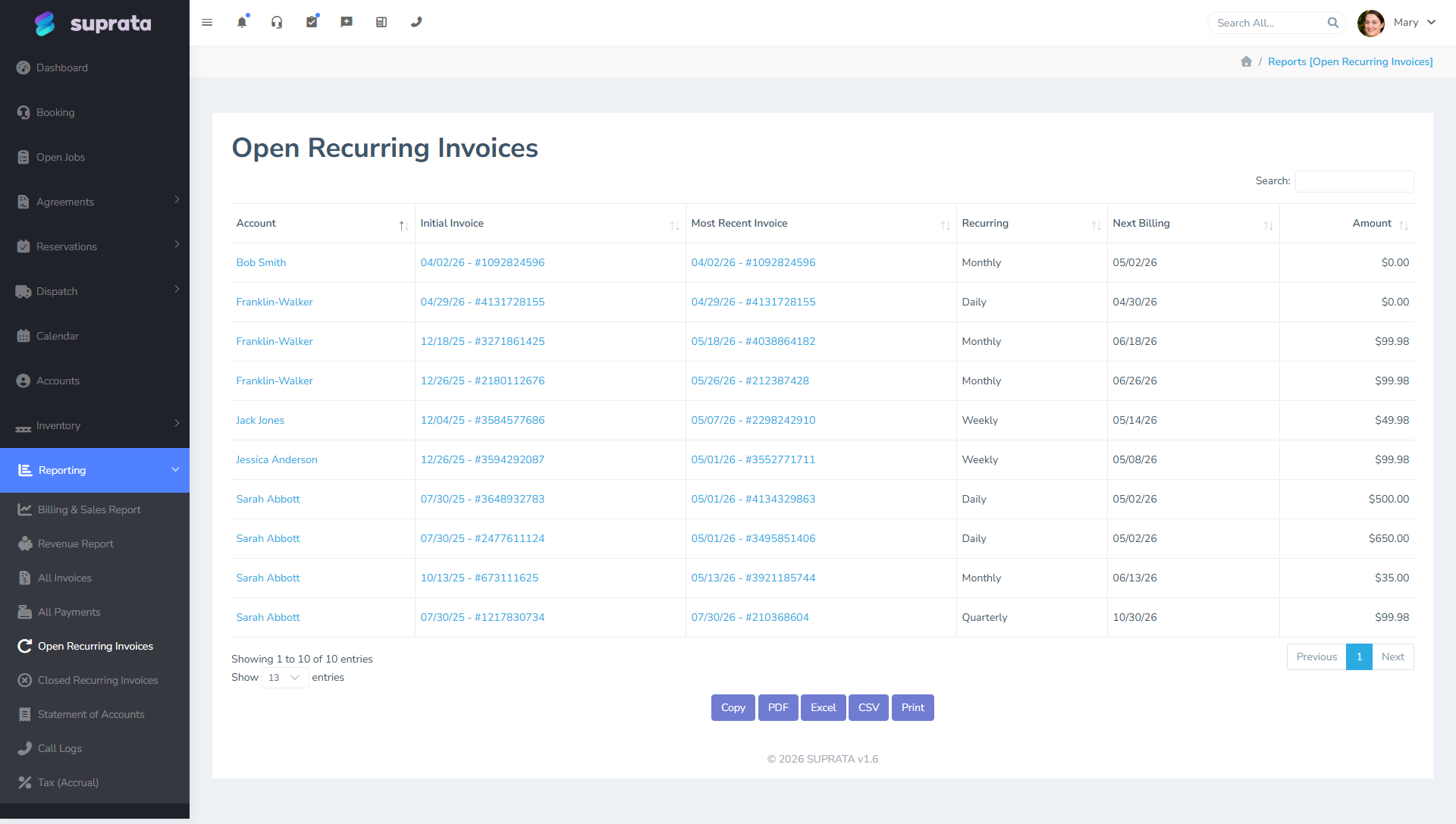
A recurring invoice is the simplest of the three: a billing-only charge that repeats on a cadence. There's no contract to sign, no service to perform, no job that gets created.
- $300/month equipment rental fee.
- Monthly retainer for an ongoing professional services arrangement.
- Annual website hosting fee.
- Storage rental outside of the reservations subsystem.
Recurring invoices are managed separately from agreements. Each cycle, the system creates a fresh invoice from the parent recurring template. If autopay is set up on the account, it gets charged. If not, it goes out for collection like any other invoice.
When you'd use each — concrete scenarios
| The customer pays you... | Use |
|---|---|
| For a recurring service visit (every quarter, every month, every spring) | Service Agreement |
| For "membership" or "tier" status with no work performed | Subscription |
| For a thing they're renting from you, billed monthly | Recurring Invoice |
| For a maintenance contract where you visit, but they pre-paid for the year up front | Service Agreement with billing-on-activation |
| For an upfront fee plus per-visit charges | Service Agreement with mixed billing |
| For one-time work | None of these — just an invoice |
| For an asset booking (slip, site, RV space) | A Reservation with a billing schedule (different system entirely) |
The decision matrix
If you can answer these three questions, the choice is automatic.
- Does this generate work for my crew?
- Yes → Service Agreement.
- No → keep going.
- Is there an entitlement / status / access being granted? (membership, priority, access to a thing)
- Yes → Subscription.
- No → keep going.
- Is the customer paying for the privilege of holding something they could give back? (rental, retainer)
- Yes → Recurring Invoice.
That's it. If you find yourself wanting two of the three for the same customer relationship, that's fine — you can have a service agreement and a subscription on the same account (e.g., they're a member and they get quarterly maintenance).
How they compare across the things people actually care about
Billing cadence
- Subscription: fixed cadence (monthly, quarterly, annually). One invoice per cycle.
- Service Agreement: depends on the contract. Could be billed at activation (pre-paid), per-visit (after each job), or on its own cadence independent of visits.
- Recurring Invoice: fixed cadence. One invoice per cycle.
What triggers an invoice
- Subscription: the system, on the cadence, period.
- Service Agreement: depends. The schedule tick may invoice, the activation may invoice, or it may be invoice-free if pre-paid.
- Recurring Invoice: the system, on the cadence, period.
What triggers a job
- Subscription: nothing. No jobs.
- Service Agreement: every schedule tick (when auto-book is on). A job appears in dispatch, ready to be scheduled.
- Recurring Invoice: nothing. No jobs.
Autopay behavior
All three can autopay if a saved payment method is on file. But:
- Subscriptions almost always should autopay — that's the model.
- Service agreements usually do, especially for residential maintenance plans.
- Recurring invoices are a mix — equipment rentals usually do, retainers often don't (the client wants to review).
Customer cancellation
- Subscription: usually cancellable on next renewal (you set the policy). Some marinas and clubs lock in for a season; configure accordingly.
- Service Agreement: governed by the contract. Most have a termination clause (e.g., "30 days written notice"). The contract length and auto-close date are set per-agreement.
- Recurring Invoice: usually cancellable any time — there's no contract.
Accounting treatment
This is where people often go wrong on the QuickBooks side. From QB's perspective, all three create regular invoices. The grouping and income classification in QB depends on which item codes you map them to:
- Map subscription items to a Membership / Subscription Income account.
- Map service-agreement items to Service Revenue (just like any other job income).
- Map recurring-invoice items to whatever they actually are (rental income, retainer income, etc.).
Your accountant cares more about how the items are mapped than about the agreement-vs-subscription distinction inside Suprata.
Real-world examples to anchor the choice
A marina selling annual moorage. That's a Reservation with a long-stay billing schedule, not any of these three. Don't try to model moorage as a subscription — you'll lose the asset (the slip), the dates, the conflict detection, and the audit walk integration.
A marina selling pool access for $1,200/year. Subscription. There's no asset booked, no service performed.
An HVAC company selling a residential maintenance plan with two tune-ups per year. Service Agreement, schedule with two ticks (May and October), billing on activation (the customer pays $200 up front, the visits are pre-paid).
An IT shop selling a monthly managed-services package — $499/mo for "we monitor your network and respond to issues." Subscription for the base fee. If they bill per-incident on top, those are regular invoices linked to jobs.
A property manager paying you a monthly retainer for on-call handyman availability. Recurring Invoice. There's no scheduled work — they call, you come — but the retainer bills regardless.
A boatyard renting a slip and doing service work on the boat that lives in it. Reservation for the slip, plus regular jobs for the service work. The reservation's account links to the same customer as the jobs.
Common mistakes
Modeling a membership as a service agreement. The schedule will keep producing empty jobs that confuse your dispatchers — there's nothing for the tech to actually do. Use a subscription instead; it bills the customer without putting anything on dispatch.
Modeling a maintenance plan as a recurring invoice. You'll bill the customer every quarter but you won't have a job in dispatch reminding you to actually go out. Three months later you realize you've been billing for service you never delivered. Service agreements exist to keep these in sync.
Trying to use one agreement for "everything ongoing" with this customer. If the customer has a membership and a quarterly service plan, those are two separate things. Don't try to fold them together — your reports won't make sense and cancellation gets messy.
Setting up subscriptions before connecting Stripe (or whichever processor). Subscriptions are pointless without autopay. Connect the processor first. You don't need a card on file before you start: when you turn on the recurring invoice in the subscription setup, you can add the customer's card (or bank account, where your processor supports it) right there, and it's saved to their account. What you should avoid is picking Manual payments "for now" and meaning to come back — that subscription will send invoices for someone to chase every cycle until somebody remembers.
Forgetting that template edits don't change active agreements. When you edit a template, it doesn't reach back and change agreements that are already running. Each active agreement keeps its own copy of the terms and items it started with. To change an active agreement, edit that agreement directly.
Putting the wrong cancellation policy in the boilerplate. The terms you put in the template show up on the signed agreement and are legally what governs the relationship. Get a real lawyer to look at it before you push hundreds of agreements through.
Migrating from one to another
If you set the wrong type and need to change:
- Subscription → Service Agreement: close the subscription, build a service-agreement template that matches the new model, activate a fresh agreement on the customer.
- Service Agreement → Subscription: same direction — close the agreement (preserving its history), set up the subscription separately. Don't try to flip an already-active agreement into a subscription; the historical jobs and invoices won't make sense.
- Recurring Invoice → Subscription: usually unnecessary. The functional difference is small. Switch only if you specifically want subscription-style cancellation tracking and renewal logic.
In all cases, don't delete history. The customer's past invoices, jobs, and signatures are real records — close them out, don't erase them.