AI Search — Asking Questions About Your Business
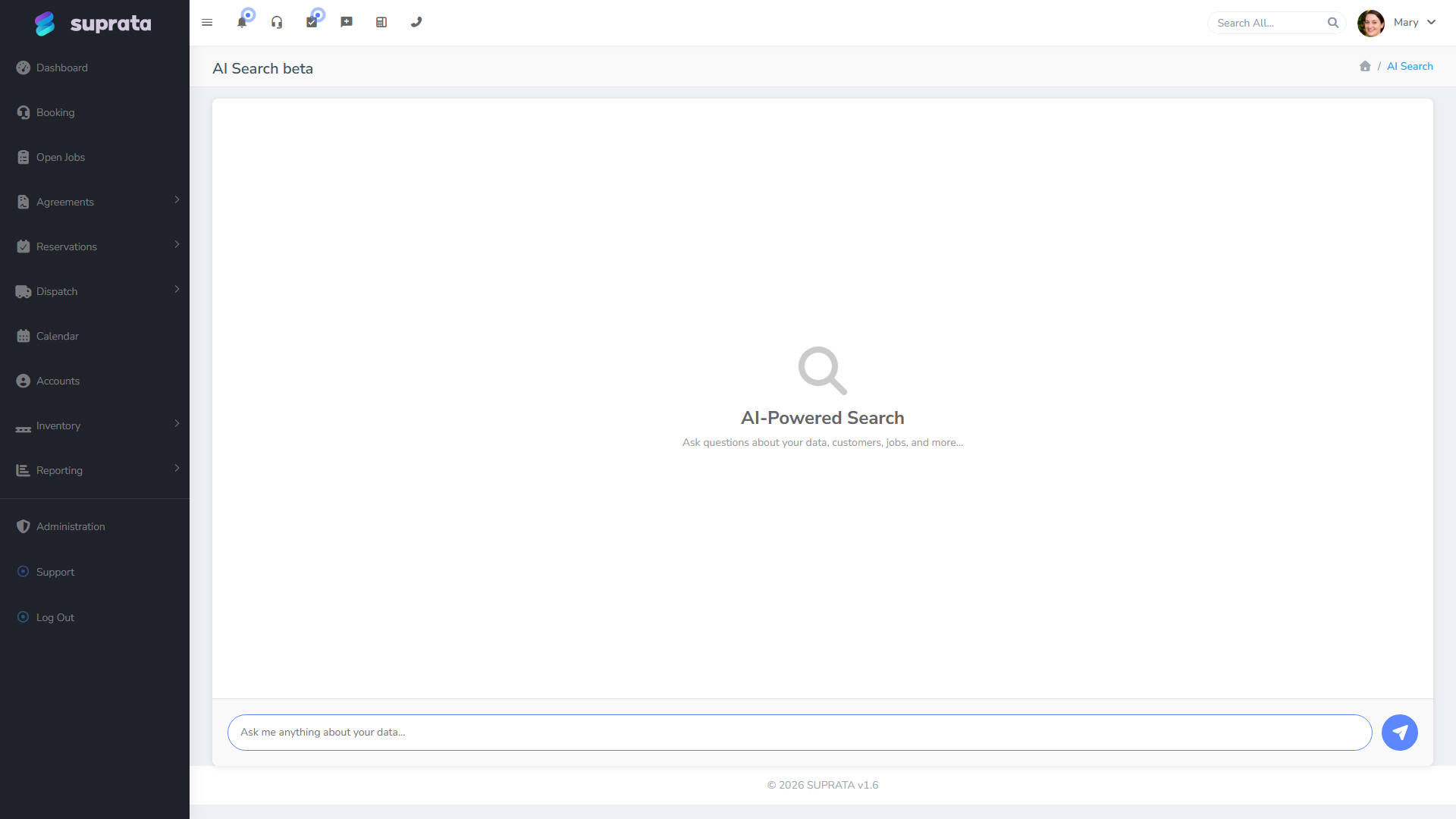
AI search lets you ask Suprata questions the way you'd ask a sharp employee who knows your business. "Which customers haven't booked anything in the last 90 days?" "What did we do for the Smiths last summer?" "Are there any open invoices over $5,000?" You get an answer in seconds, drawn from your own accounts, jobs, invoices, and notes. It collapses what would otherwise be five reports and a spreadsheet into a single question.
This is one of the highest-leverage features in the product. Use it.
When you'd use this
- You want context on a customer before a phone call and don't have time to dig through notes.
- You're looking for a pattern across the business — "any accounts we haven't touched in six months?" — that no single report quite answers.
- You're new to Suprata and don't yet know which screen holds what. AI search is often the fastest way to find a record.
- A teammate just asked you a question and you want the answer without leaving what you're doing.
- You want a quick read on the day, the week, or the month: "what's been happening on the commercial accounts lately?"
What it's great at
- Recall. "What's the history with this account?" "When did we last do work for them?" "What was the last conversation we had?"
- Summarization. "Summarize the last 10 jobs we did this month." "Give me a quick read on Smith Industries."
- Open-ended exploration. "Anything unusual in the past week?" "Any accounts that look like they're slipping?"
- Cross-record questions. "Find me jobs where the technician left a note about needing a return visit."
- Finding the right record fast. "The customer in Boca with the broken HVAC — pull up that account." Beats scrolling a list.
These are the questions where an experienced employee would just know — and AI search is, effectively, that experienced employee.
How to ask good questions
A few habits make answers sharper:
- Be specific about the time window. "Last month" can be ambiguous. "March 2026" or "the last 30 days" gets cleaner answers.
- Name the entity precisely if you know it. "Smith Industries" is fine if the name is unique; if not, include the city or account ID.
- Ask one thing at a time. Stack questions and the answer gets vague. Break compound questions into a sequence.
- Follow up. "Of those, which are over $1,000?" "Which haven't been touched in a month?" Each follow-up sharpens the result.
- Talk like a person. You don't need keywords. "Which customers seem unhappy lately?" works.
What you can do with the answers
The most common workflow:
- Ask the question.
- Read the answer.
- Click into the records the answer references to act on them — call the customer, send a follow-up, build the invoice, whatever the next step is.
AI search is most valuable as the starting point — it surfaces what you should look at next. The records themselves are where the work happens.
A note on accuracy
AI is excellent at reading, summarizing, and pattern-spotting. It is less reliable at exact counts and totals — language models are not databases. So:
- For orientation, recall, and pattern-finding, trust the AI answer and act on it.
- For numbers you'll commit to — billing decisions, tax filings, customer-facing totals — verify against the underlying reports. The reporting tools are your records. AI search points you at things; reports give you defensible numbers.
This is the same calibration you'd apply to a smart assistant: brilliant for "what's going on?", not the right tool for "give me the exact figure I'll put on a tax return."
Privacy
AI search reads only your tenant's data — your accounts, your jobs, your notes. Conversations are not used to train the model. The same data-handling expectations you have for the rest of Suprata apply here.
Common mistakes
- Phrasing the question too vaguely. "How are we doing?" gets a vague answer. "How does this month's revenue pace compare to last March?" gets a useful one.
- Stopping at the AI answer when an exact number matters. For anything you'll commit to in dollars, click through to the Billing & Sales Report before you act.
- Not following up. The first answer is usually a starting point. Two or three follow-up questions almost always sharpen it into something actionable.
- Forgetting AI search exists when you're hunting for a record. It's often faster than navigating menus. When you're about to scroll through a list to find someone, ask first.